March 18th, 2014 § § permalink

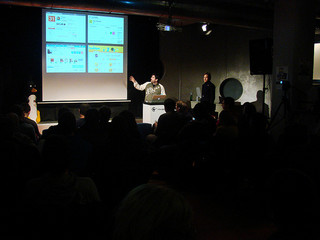
#190: Twenity – lansiranje – NOVOLETKA, 21. Dec 2011 (Photo credit: Kiberpipa)
Slovenia has incredibly healthy startup community, with probably largest amount of global startups per capita. Most of the public is still unaware of how different (and healthy) work environments these young and fast-growing companies are.
After super successful first startup crawl amongst Ljubljana startups (last October), when literally hundreds of people came to visit some of us, the InternetWeek.si team is rallying us together again, in an even more awesome all-day startup festival.
As of today we have 24 super interesting startups opening doors for visitors, ranging from global super stars like Outfit7 and Celtra, to most ambitious newcomers like Sqwiz, Dietpoint and Oculus.
Let me rephrase this – this Friday you have an unique opportunity to see how Outfit7 and Celtra look like from within and talk to them in person!
A totally unique chance if you are looking for a better job (in various roles, not just engineering), if you are a journalist, consultant, or just a worried parent of a high-schooler that likes internet a lot.
This year we are also not only limited to Ljubljana anymore – we have startups from Ptuj, and Kranj participating as well.
So, here’s a recipe for you for this week:
- TODAY: go to internetweek.si and checkout the list of participating startups
- TODAY: BOOK A TICKET with the ones that you are interested in – the quantities are limited, with some of them very limited
- FRIDAY: go have a chat with some of the only creators of jobs in Slovenia
- FRIDAY EVENING: after party in LP in the center of Ljubljana
If you are a startup as well, and are wondering why you are not on the list, all you have to do is send an email to the internetweek team!
August 20th, 2013 § § permalink


Fred Wilson (Photo credit: Wikipedia)
We launched a fun new featurette today—the tech circle. You can read more about it on our main blog, and on Fred Wilson’s blog, but in essence it is a showcase for our latest product, the content discovery network.
This was my first product launch again in years, so I couldn’t sleep really. But not simply because something was going to go live.
Since Fred was leading the pack with his blog post, and since Fred blogs early in the morning, we had to flip the switch on his blog before he wakes up. Because all blogging tools are somewhat old, the best way to do that is to actually put some code into the design of the site.
I’ve had Fred’s
google analytics access for a while now, and now he shared his blog access as well. So I had the honor to hack my way trough Typepad’s opaque templating system. Of course I first tried on a test blog, and of course the templates changed on the live blog as well while I was still figuring out how it all works. Hopefully nobody noticed. 🙂
Anyways, our recommendations have now connected together a group of very interesting product people from very different backgrounds. Would love to hear your comments on it, and would love to hear if anyone would want to start a new circle with some of your blogging friends.
August 19th, 2013 § § permalink

Startup screen (Photo credit: Wikipedia)
Economic crisis is still the dominant topic in Slovenia, with worrying news and indicators popping up daily. At the same time, Zemanta has never been better, and is actually growing fast. Of course, because we are active on global market, rather than dependent on local economy. Except in one aspect – hiring.
We are looking for several new exceptional colleagues in our Ljubljana office. brilliant, smart, ambitious software developers. It’s not surprising that a lot of people are applying for the position, and I’m very happy to see that many of them actually fit the profile we are looking for.
I’m starting to call it ‘startup engineer‘, to differentiate it from other software development jobs, like traditional IT, systems integrations or website development. many students coming from the universities here are not aware of the difference, and I think we, the startups, have to be very loud about how differently we work. here is a short list of the type of differences, would love to compile a longer one with your help:
- problem-solving: we are a product company, building a product of our own. there is no external client inventing and changing the specs all the time. there is no map of where we are going. we are learning with every step what the next step will be. thus there are not many repetitive tasks. every day actually brings new challenges. some people don’t handle such uncertainties well. startup engineers thrive in the challenge.
- freedom and flexibility: to a large extend we don’t care when and how you work. we expect you to do what it takes to understand the challenge well enough, to tell the other how you will solve it. hours, days, languages, locations are up to your judgment. some people cant handle this freedom. startup engineers love the freedom and grow with the responsibility.
- curiosity: the world is changing with incredible and accelerating speed, and we need to stay a step ahead of it. we need to understand the emerging technologies before they become standards. it takes extra time and energy, that doesn’t necessarily pay off always. startup engineers experiment and learn, because they cannot not to. sometimes that’s called being brave.
- global view: even when working on local problems, startup engineers have to understand the world at large, keep in touch with global trends, and think how the flap of the butterfly in silicon valley will affect us here and now.
there are several practical challenges that we are facing when trying to communicate why working in a startup should be attractive option:
- I wish in the future, people looking to work as developers, would be aware of this difference well in advance. ideally even before high school, so that they can optimize their learning for the style of work that suits them best. we see a lot of very compelling candidates, that unfortunately end up working for banks and IT companies, simply because they don’t know that being a developer can mean very different things.
- there is a prejudice that startup jobs are not stable enough, so specially young candidates are discouraged from applying for them. I find this mentality particularly cynical and obsolete. not only have I met a lot of very stable and healthy startups over the years, also the ‘stable’ companies are laying off incredible amounts of people these days, and government jobs are less and less secure as well.
- some candidates, if they happen to know about startups, are convinced that they are not good enough to qualify. they don’t realize that what we need is first and foremost smarts and curiosity, and not PhD quality of theoretical puzzle-solving. at Zemanta, cultural fit is much more important than skills and experience. don’t negotiate with yourself.
I wish we could make this, ‘startup engineer’ a formal post-graduate university program. there are practical skills they could learn, to accelerate their growth, but these will change from year to year. more importantly, by having it as an option within formal educational system, we would be raising the awareness and actually giving some of the students a fair chance to realize their potential. creating it in collaboration with the actual companies would make sure the students end up with a bit more practically useful knowledge built on top of computer science fundamentals, and give them direct access to a pool of employers, that have been doubling every year.
March 18th, 2013 § § permalink

I gave several book interviews since starting Zemanta and moving to NYC, most of them in the last 18 months. Lots of authors are exploring the technology revolution that we were fortunate to participate in.
Books are coming this year, discussing it from various angles – comparatively with .com boom, the rise of entrepreneurship Europe, new entrepreneurship as a lifestyle, … It is no surprise to me, that the first book to actually publish is the one specifically celebrating NY tech community and agility and resilience.
Tech and the City became available on Kindle two days ago, and hardcopies are coming in April. I received the notification from the authors this morning, and already I’m half way trough it. It’s that good.
It starts with an amazingly inspiring foreword by Fred Wilson, which alone is worth the $2.99, as it perfectly outlines the mental model of the greatest city on the planet. After that, the book only gets better, weaving the story trough fragments of conversations with participants in the ecosystem, rather than lazily throwing together yet another series of interviews. This enables the book to read like a travel diary, rather than a self-hype-help business manual.
For the finish, the authors have collected a very comprehensive list of the NY tech ecosystem institutions – vc’s, events, co-working spaces and competitions. They have also published them on the official blog of the book.
It’s cheap and it’s short, and it’s awesome. Go read it and learn how you should be thinking about helping entrepreneurs in your cities / countries.
May 16th, 2012 § § permalink


Groucho Marx & anonymous blogging (Photo credit: Wikipedia)
I’m late to the game, probably everyone knows already, but for the record:
Life just got a little easier for bloggers who use TypePad. The hosted blogging platform announced that it is integrating Zemanta’s content recommendation tools into its service, which suggests links to related stories from across the Web. Zemanta also generates in-text links to related information.
via: www.readwriteweb.com
… when we started 5 years ago, we had a list of most relevant blogging platforms of all times. now all of them are our partners 🙂 it feels empowering and inspiring to make dreams happen, but you have to remind yourself of that achievement, because when you reach them, you have other dream already.
April 7th, 2012 § Comments Off on time for “Push PR” § permalink


An Empire of Silly Statistics…A Fake War for Public Relations (Photo credit: Marquette University)
Ernest is entirely right – PR companies just don’t get the fact, that we don’t care what they think should interest us – that’s what it means being ‘independent’:
www.ernestbarbaric.com
At some point in the last year or so, someone pegged me as an influential blogger… and then it started. A constant and never-ceasing stream of daily e-mails from various PR companies mindlessly clogging up my inbox.
It does not, however, mean that PR is dead – there clearly is a need for ‘public relations’. the need is actually much larger than it ever was, on both sides –
corporate communications as much as on the receiving end – bloggers have to be current and informed, just like journalists had to be.
I believe the solution is in making PR more pushy.
As a writer, I expect the right content to come to me, I don’t want to seek it out. In that sense, I expect it to be pushy, but also highly targeted and personalized. Just like it used to be, back in the days when there was roughly as much PR professionals as there were journalists, and the two crowds well managed eachother.
as the new media grew, keeping up with targeting became impossible, and now they rely on ‘curated’ lists of thousands of bloggers, they never really looked at. I believe that’s where we at
Zemanta make a huge difference – I often link PR messages from my posts, because they are recommended to me exactly when I’m writing about the topics they adress, so they actually provide value to me – I would never go look for them otherwise.
Pushy is not spammy, if done right. But there is no way you can do PR right without help from algorithms these days.
April 1st, 2012 § Comments Off on SeedTable – finally a decent overview of startups § permalink

I love projects that make large datasets usable. This one took way to long to be done, but finally – now we can stop wasting clicks and get an executive summary of our city’s startups. 🙂
Also, I will take this opportunity to invite you all for a sneak peek at East Start Map – please let me know what we’re missing.
 I have a love/hate relationship with CrunchBase. On the one hand it has great information about startup tech companies. On the other hand, it relies on a wiki-like structure which means it is sometime not updated as frequently or as accurately as old-style databases which used to employ people go over the data regularly.
via: techcrunch.com
March 20th, 2012 § § permalink


Image via Wikipedia
this is incredibly important – how to keep two parts of remote organization connected:
Some companies are almost entirely virtual, like blog host Automattic. Others grow through acquisitions, like what Groupon is doing in the Bay Area – piecing together a tech team thousands of miles from its Chicago headquarters. Another strategy is to build strategic outposts, like Facebook’s new engineering office in New York.
via: allthingsd.com
we are doing many things in a similar way over at Zemanta.
Since our Ljubljana office is much larger than NY one, we only have a big screen in Ljubljana, but as soon as we set that up, everybody started using it for cross-ocean meeting. I’m actually thinking we will need a second one soon. we’ve learned that sound quality is much more important than anything though.
ever since our NY office was just one person, I insisted on making weekly check-in meetings with everyone. it has grown to be a well-self-moderated debrief from both sides. it turned out that on every meeting several people are dialing in, because they are traveling, sick, or just work remotely. point being: don’t make it an excuse for not having a meeting, embrace the remoteness.
and travel – we realized that US and EU cultures are so much different, that it’s essential for everyone to get to know the other. so we do 1 or 2 all-company weeks per year, where everyone from US comes to work from Ljubljana (and more than just work of course). at the same time, there is almost always someone of the developers working from NY office, just for the kicks of it.
and despite all these efforts, quite often a mediation is required, because people assume the other person is thinking about something else.
you might recall the Sunscreen verse: “Work hard to bridge the gaps in geography and lifestyle” – well, it’s true for the people you work with, not just friends.
February 13th, 2012 § Comments Off on Federated, Zemanta Launch Program to Connect Bloggers with Brands § permalink

I rarely write about my company here, but i’m exceptionally proud of this one:
 Federated Media Publishing and Zemanta have announced a strategic partnership that will use technology to make it easier for bloggers and companies to connect, increasing opportunities to create targeted content marketing campaigns.
via: www.contentmarketinginstitute.com
Federated Media and John Battelle have been role models for all of us for years, and it’s a privilege to work with them.
January 29th, 2012 § § permalink

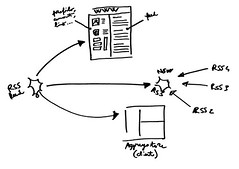
Image by francescopozzi via Flickr
this is by far best summary of reasons I have seen so far. all true, all tried:
I often argue that professionals should share their knowledge online via blogging. The catch is that virtually anything worthwhile in life takes time and effort, and blogging is not an exception to this statement. So before committing your energy to such an endeavor, you may rightfully stop and wonder what’s in it for you. Is blogging really worth it?
via: technicalblogging.com
… in reality, every bloggers cares about one or two of these points. for me they are (1) improve communication skills, and (3) personal repository. they were the reason I started blogging myself. and then, after a while, all other benefits creep into your life and y
ou get used to them. and people start calling you blogger. then, you should always keep in mind the ones that get you going in the first place, in order to stay true to yourself. the readers can detect when you start deceiving them and they will go away.


